Same-day deliverycall by 12 PM
OSHA Porta Potty Requirements for Construction Sites
OSHA porta potty requirements for construction come from 29 CFR 1926.51. A crew of 20 or fewer needs at least 1 toilet. Bigger crews need 1 seat and 1 urinal per 40 workers, then per 50 at 200 workers. Texas job sites follow federal OSHA. Below is the rule, then what we suggest for weekly service.
Call or text dispatch(936) 213-8620Calls answered live Mon–Sat, 7 AM–7 PM. Online quotes answered within 30 minutes.
What does OSHA 1926.51 Table D-1 say?
OSHA 1926.51(c)(1) sets toilet counts with a 3-row table called Table D-1. A crew of 20 or less gets 1. A crew of 20 or more gets 1 seat and 1 urinal per 40 workers. At 200 or more, the rule drops to 1 seat and 1 urinal per 50.
| Number of employees | Minimum number of facilities |
|---|---|
| 20 or less | 1 |
| 20 or more | 1 toilet seat and 1 urinal per 40 workers |
| 200 or more | 1 toilet seat and 1 urinal per 50 workers |
The other parts of paragraph (c)
- (c)(2) Field conditions: under "temporary field conditions," at least 1 toilet facility must be available.
- (c)(3) No sewer: sites without a sanitary sewer use privies, chemical, recirculating or combustion toilets, unless local codes say no. A porta potty is a chemical toilet.
- (c)(4) Mobile crews: the toilet rules "shall not apply to mobile crews having transportation readily available to nearby toilet facilities."
The standard PolyJohn PJN3 has a seat and a urinal inside one unit. Ask your safety officer how your site counts it against the table. Read the full text of OSHA 1926.51 Sanitation.
How many toilets per worker does OSHA require?
OSHA requires about 1 toilet per 40 workers on crews of 20 to 199. At 200 or more, the ratio is 1 per 50. That is a legal minimum, not a comfort level. Willie Rental Works recommends 1 unit per 10 workers on a 40-hour week. Then tanks last until the weekly visit.
| Crew size | OSHA Table D-1 minimum | We recommend |
|---|---|---|
| 5 | 1 | 1 |
| 10 | 1 | 1 |
| 15 | 1 | 2 |
| 20 | 1 | 2 |
| 25 | 1 seat + 1 urinal | 3 |
| 40 | 1 seat + 1 urinal | 4 |
| 50 | 2 seats + 2 urinals | 5 |
| 80 | 2 seats + 2 urinals | 8 |
| 100 | 3 seats + 3 urinals | 10 |
| 150 | 4 seats + 4 urinals | 15 |
| 200 | 4 seats + 4 urinals | 20 |
| 250 | 5 seats + 5 urinals | 25 |
The OSHA column rounds up each partial group of 40 or 50. Our column assumes 1 service visit per week. A second weekly visit can stand in for some of those units.
Worked example: a concrete crew of 32 pours slabs 45 hours a week. OSHA asks for 1 seat and 1 urinal. Our guideline gives 32 ÷ 10, rounded up to 4 units.
The crew passes 40 hours, so we would add 2 units or a second weekly service. The porta potty calculator runs this math for any crew size.
Does OSHA require hand washing on a job site?
OSHA 1926.51(f)(1) requires "adequate washing facilities" for crews applying paints, coatings, herbicides or insecticides. The same applies to any work with harmful contaminants. Paragraph (f)(3) adds lavatories with running water, soap and towels. Mobile crews who can drive to nearby sinks are the 1 exception.
The washing rule also says facilities "shall be maintained in a sanitary condition" at all times. Painters, drywall finishers and roofers handling sealants all fall under the first line.
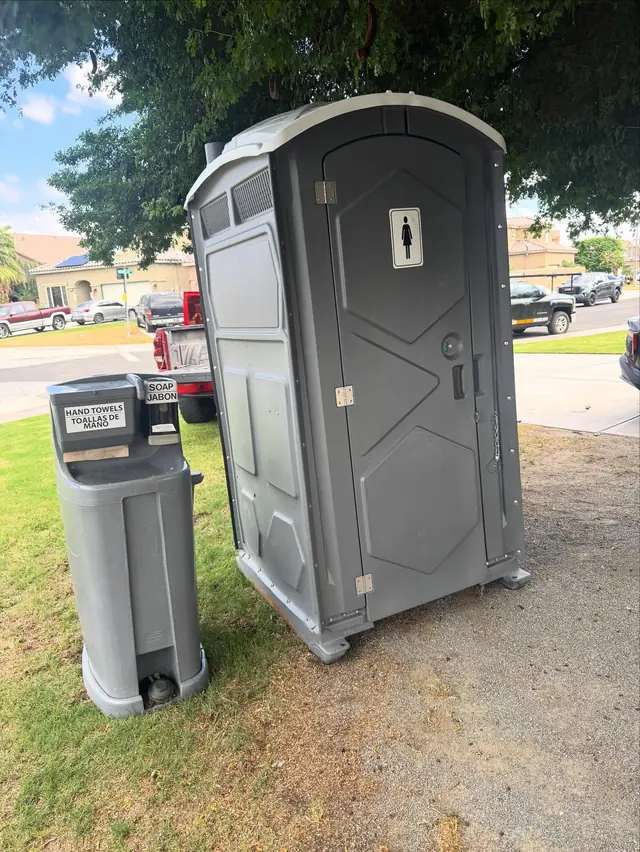
A two-station sink covers most residential crews. See hand washing station rental for sizes and refill service.
What are the OSHA toilet rules for farms?
OSHA 1928.110 requires 1 toilet and 1 handwashing facility for each 20 field workers or fraction. Both must sit within a one-quarter-mile walk of each worker. The rule covers farms with 11 or more hand laborers on any given day. Work of 3 hours or less, travel included, is exempt.
The farm rule also spells out privacy. Doors must be self-closing. They must also lock, or in the rule's words, be "closed and latched from the inside" by the user. Where terrain blocks that, facilities go at the closest point a vehicle can reach.
Read the full OSHA 1928.110 field sanitation rule. Harvest seasons often run 28 days or longer, so see monthly porta potty rental.
Which OSHA rules apply to job sites in Texas?
Federal OSHA rules apply to private job sites in Texas. Texas is 1 of the states without an OSHA-approved State Plan. No separate state toilet count exists for private employers. Your general contractor, the city or the project spec may still ask for more units than the federal minimum.
Shops, offices and warehouses fall under the general industry rule, 1910.141. Its Table J-1 starts at 1 toilet for 1 to 15 employees and 2 for 16 to 35.
How do heat and service visits change the count?
Heat changes the count more than crew size alone. Workers drink more water from June through September, so tanks fill faster. A crew of 10 may get by on 1 unit in March. In August, that crew may need 2 services a week. Each unit holds 60 gallons before it needs a pump-out.
OSHA 1926.51(a) also requires "an adequate supply of potable water" on every site. More drinking water means more restroom use, so plan both together.
Weekly service comes with every 28-day construction porta potty rental. Twice-weekly service is available for busy crews.
OSHA porta potty questions from contractors
These 6 answers cover the OSHA questions contractors ask before a crew mobilizes: small crews, subs, cleaning, mobile crews and cost. Each answer opens with the rule or the number. For a full price breakdown, see the porta potty rental cost guide.
Does OSHA require a porta potty for a 2-man crew?
Table D-1 sets a minimum of 1 toilet for 20 or fewer workers. That minimum includes a crew of 2. The exception is a mobile crew with transportation readily available to a nearby restroom. A crew parked at one house all week is not mobile.
Do subs count toward the total?
OSHA counts the employees on the site, and most general contractors count every trade working that day. Add the framers, electricians and plumbers together on your peak day. Ask your safety officer how your contract splits the duty.
Does OSHA say how often it has to be cleaned?
OSHA 1926.51 sets no cleaning schedule in days or visits. Washing facilities must be "maintained in a sanitary condition," and the farm rule says the same for toilets. Our 28-day rentals include 1 service visit per week, and extra visits cost $45 each.
We're a roofing crew that moves every day. Do we need one?
Mobile crews with transportation readily available to nearby toilets are exempt under 1926.51(c)(4). A truck and a restroom 5 minutes away may fit that line. A 3-day tear-off on one house is a different case, so check with your GC.
Can the homeowner's bathroom count for the crew?
OSHA does not ban using an existing restroom on site, but the homeowner has to agree. Most remodels shut off water or plumbing at some point. A standard job-site unit runs from $175 for each 28-day cycle with weekly service. Delivery is $65 and pickup is $30, each charged once.
Do we need a separate unit for women on the crew?
Table D-1 in 1926.51 does not split counts by sex. Single-occupancy porta potties with a door latch serve anyone. Some contracts ask for a marked unit, which we can deliver as an extra standard unit.
Get a quote that meets your crew count
A crew-count quote needs 4 facts: peak crew size, weekly hours, the site address and the start date. We check the count against OSHA Table D-1 and our 1-per-10 guideline. You get both numbers in writing, so your safety officer can sign off before the units arrive.
Calls answered live Mon–Sat, 7 AM–7 PM. Online quotes answered within 30 minutes.
Crew starting this week?
Call with your crew size, and we will match the count to OSHA and your schedule.
Calls answered live Mon–Sat, 7 AM–7 PM. Online quotes answered within 30 minutes.